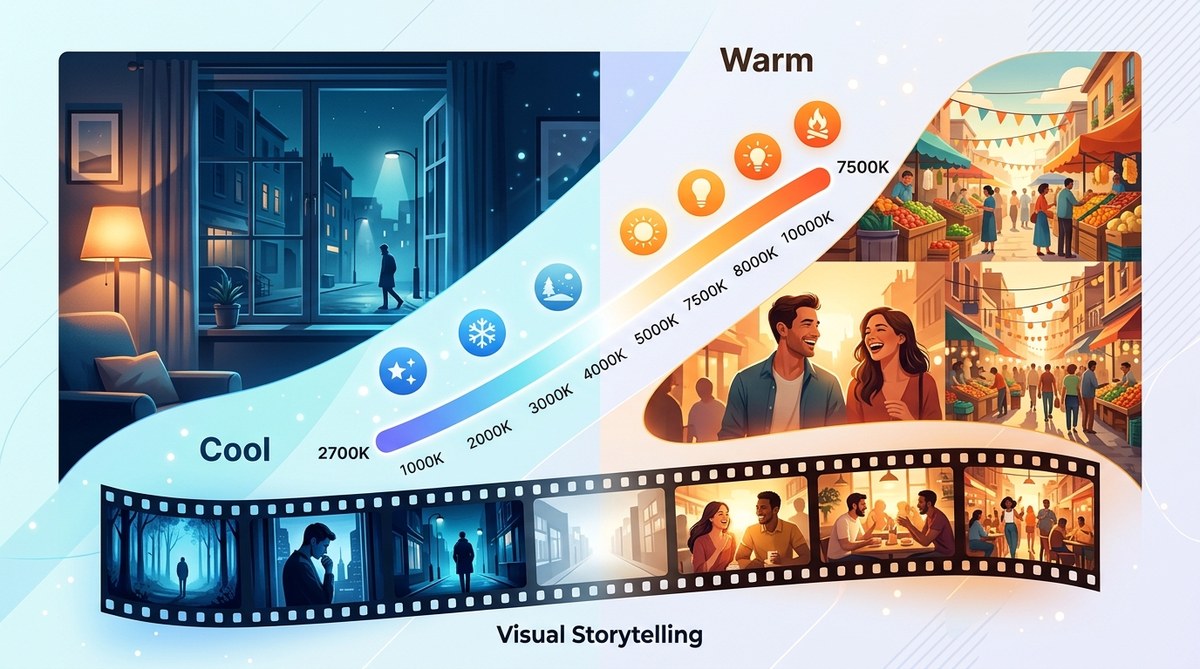
The sun dips below the horizon, and the world turns a deep, golden orange. You feel calm, maybe a little nostalgic. Now walk into a fluorescent-lit office. The air feels sterile, cold, and slightly tense. That shift in your gut is not an accident. It is the direct result of color temperature. You already know the technical definition: measured in Kelvin, warm light sits around 2000K and cool light climbs past 6000K. But knowing the numbers is not enough. The real power of color temperature lies in how it makes your audience feel. When you master the emotional language of warm and cool light, you stop just recording scenes and start telling stories with light itself.
Color temperature is not just a white balance setting. It is a direct emotional cue for your audience. Warm light (low Kelvin) signals safety, intimacy, and nostalgia. Cool light (high Kelvin) signals isolation, tension, and technology. By deliberately shifting between these two poles, you can guide viewer emotion, reveal character psychology, and strengthen your narrative without a single line of dialogue.
Warm Light Feels Like Home
Your audience has been conditioned by a lifetime of experience. Candlelight, sunrise, and the glow of a fireplace all sit in the warm range of 2000K to 3500K. These are moments of rest, connection, and safety. When you light a scene with warm tones, you are borrowing that emotional shorthand.
Think about a character coming home after a long day. The kitchen is lit by a single warm lamp. The audience relaxes because the light tells them this is a safe space. You can use this for romantic scenes, family dinners, or moments of quiet reflection. Warm light wraps your subject in a visual hug.
But warm light can also be used to create unease. A room that is too warm, pushing into deep amber or red, can feel oppressive. It can signal fever, anger, or a memory that is fading. The key is intention. Ask yourself what feeling you want the audience to have. If it is comfort, keep your light source soft and your Kelvin value low. If you want discomfort, push the warmth past what feels natural for the environment.
Cool Light Creates Distance
Cool light, from 5000K to 7000K, mimics overcast skies, moonlight, and fluorescent office fixtures. These are environments where people are alert, exposed, or alone. Cool light makes skin look pale and shadows feel sharper. It is the light of hospitals, interrogation rooms, and cold winter mornings.
Use cool light when you want your audience to feel a character’s loneliness. A single figure sitting in a blue-lit apartment feels isolated even if the room is full of furniture. Cool light can also signal a character who is emotionally closed off. Think of a detective who has seen too much. Their office is lit by a harsh overhead fluorescent tube. The cold light reflects their internal state.
One of the most powerful techniques is the cool shift. A scene starts warm and comfortable. Then something changes. A door opens. A secret is revealed. The light shifts cooler. The audience feels the emotional temperature drop before the character says a word. That is the magic of color temperature visual storytelling.
Mixing Warm and Cool for Conflict
The most visually interesting scenes often live in the tension between warm and cool light. This is where you can show conflict, both internal and external. A character standing in a doorway, half their face lit by warm interior light and half by cool moonlight, is literally split between two worlds.
You can use mixed lighting to show a character’s duality. A warm key light on one side of their face suggests their softer side. A cool fill light on the other side reveals their guarded nature. The audience reads this conflict instantly, even if they do not know why they feel it.
Here is a simple table to help you plan your lighting choices for specific emotional beats:
| Emotional Goal | Lighting Approach | Common Mistake |
|---|---|---|
| Safety and intimacy | Single warm source, low contrast | Using cool fill light that washes out the warmth |
| Isolation or tension | Cool ambient light, hard shadows | Making the light so blue it looks like a special effect |
| Internal conflict | Split lighting (warm key + cool fill) | Balancing the two sides equally, which creates confusion |
| A character’s memory | Slightly warmer than the present scene | Shifting temperature mid-shot without a narrative reason |
| Danger or urgency | Pushing cool light green or magenta | Forgetting to white balance for the dominant source first |
Three Steps to Use Color Temperature as a Narrative Tool
You do not need a million dollar lighting kit to start using color temperature emotionally. You just need a plan. Follow these three steps on your next project.
-
Write the emotional arc of the scene first. Before you think about lights, write down how you want the audience to feel at the start, middle, and end of the scene. Do you want them to feel safe and then uneasy? Do you want them to feel cold and then slowly warmed by a character’s kindness? The emotional arc comes first. The color temperature supports it.
-
Choose your dominant light source and set its Kelvin value. Decide what the main light in the scene is. Is it a window? A lamp? A TV screen? Set that light to a specific color temperature that matches your emotional goal. For a cozy night in, set your key light to around 3200K. For a tense morning after, set it to 5600K. Lock that in before you add any other lights.
-
Use a second source to create a shift. The real storytelling happens when the dominant temperature changes. A character walks from a warm living room into a cool kitchen. The door closes, and the mood shifts. You can also shift the light on a character’s face as they have a realization. A subtle change of 500K to 1000K is enough to feel significant without looking like a technical error.
“Light is the most powerful tool we have to tell a story without words. Color temperature is the grammar of that language. Once you learn it, you can write any emotion you want.”
Practical advice from a working cinematographer on a 2026 indie film set.
Common Pitfalls That Break the Spell
Even experienced filmmakers make these mistakes. Knowing what to avoid will save you time and keep your audience in the story.
- Mixing color temperatures without intention. A warm key light and a cool fill light can look great if it serves the story. But if it is an accident, it just looks like you forgot to gel your lights. Every color temperature in your frame should be a conscious choice.
- Relying only on post production. You can shift color temperature in your editing software. It is a powerful tool. But it is not a substitute for getting the light right on set. Pushing a cool image warm in post often introduces noise and banding. Get as close as you can in camera.
- Ignoring the skin tones. The audience is wired to read faces. If your color temperature makes skin look green or purple, the audience will feel something is off, even if they cannot name it. Keep your subject’s skin tone in a natural range unless you have a specific narrative reason to distort it.
- Using the same temperature for the whole film. A consistent look is good. A completely flat emotional landscape is not. Even a subtle shift between scenes can signal a change in time, location, or mood.
For more on how to build cohesive color schemes that support your storytelling, read our guide on mastering color harmony to elevate your visual designs.
The Emotional Palette of Specific Kelvin Values
To help you make faster decisions on set, here is a bullet list of common Kelvin values and the emotional shorthand they carry.
- 2000K to 2700K (Candlelight, Sunset): Intimacy, romance, mystery, the past. Use for love scenes, campfires, or moments of deep personal truth.
- 3000K to 3500K (Tungsten, Warm Household): Comfort, safety, home, routine. Use for family dinners, living rooms, or scenes of normalcy.
- 4000K to 4500K (Neutral, Morning Light): Honesty, clarity, reality. Use for interviews, newsrooms, or moments of revelation.
- 5000K to 5500K (Daylight, Midday Sun): Energy, truth, harshness. Use for outdoor scenes, high stakes, or moments of confrontation.
- 6000K to 7000K (Overcast, Shade, Fluorescent): Isolation, coldness, technology, danger. Use for hospitals, offices, or characters who are emotionally shut down.
How to Use Shifts Between Scenes
Color temperature visual storytelling is not just about what happens inside a single shot. It is also about how the light changes from one scene to the next. This is a subtle but powerful way to show a character’s journey.
Imagine a love story. The first meeting happens in the warm glow of a coffee shop (3200K). The second date is a walk in the park under daylight (5500K). The first argument happens in a cool, empty parking lot (6500K). The reunion happens back in the warm coffee shop. The audience feels the emotional journey through the light alone.
You can also use shifts to show time passing. A scene at golden hour (warm) cuts to a scene at midnight (cool). The shift is natural and the audience reads it as the passage of time. But you can also use an unnatural shift. A character walks out of a warm hospital room and into a cool hallway. The shift is sudden. It tells the audience that something has changed.
Your Next Step
The best way to learn color temperature visual storytelling is to practice with a single light source. Take a lamp in your house and move it around. Watch how the shadows change. Notice how the color of the light affects your own mood. Then try it with a scene you have already shot. Reshoot it with a different color temperature. See how the meaning of the scene changes.
Start small. Pick one scene from your next project. Write down the emotional goal. Choose a dominant color temperature. Then make one intentional shift. You will see the difference immediately. Light is not just there to make things visible. It is there to make things felt.
If you want to go deeper into building visual harmony across an entire project, check out our article on unlock the secrets of color harmony for perfect visual balance. It will help you connect your color temperature choices to your overall color palette.
Light Tells the Story You Cannot Write
Color temperature is not a technical hurdle to clear before you get to the fun part. It is the fun part. It is the cheapest, most effective way to control how your audience feels from one moment to the next. The next time you set up a shot, stop thinking about the Kelvin scale as a number. Think about it as a feeling. Ask yourself: is this scene warm or is it cold? And why? The answer will guide your hand, your eye, and your story.